Card Author:
Location:
Date:


The church of San Francesco was initially titled in Santa Maria, and consecrated in 1149 by Monsignor Aldobrandini, bishop of Orvieto. In confirmation of the original dedication to Santa Maria, we still find the Assumption of Mary depicted in the lunette of the church facade, as well as the inscription inside the church on the triumphal arch “Assumpta est Maria in coelum”.
Info: Toll-free number: 800-411834
torrejulia@tiscali.it www.laperegina.it
Municipality of Acquapendente Tourist Office 0763 7309206; turismo@comuneacquapendente.it;
Parish: Tel: 0763/734200


CHURCH OF SAN FRANCESCO
THE HISTORY
Initially named after Santa Maria, the church of San Francesco was consecrated in 1149 by Monsignor Aldobrandini, bishop of Orvieto. In confirmation of the original dedication to Santa Maria, we still find the Assumption of Mary depicted in the lunette of the church facade, as well as the inscription inside the church on the triumphal arch “Assumpta est Maria in coelum”. Initially officiated by the Benedictines, it was granted on 20 July 1255 by the Abbot of the Holy Sepulcher to the Friars Minor based in Acquapendente at the church of Santa Croce di Monte Adamo, outside the Ripa gate. In 1747, with the intention of restoring vigor to the church building, the friars had a series of interventions carried out sacrificing the original Gothic forms for a Baroque style solution, leaving only the part of the choir in its original form.
DESCRIPTION
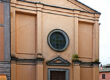
The façade of the church has a gabled layout in its simple forms typical of the minor friars. As a decoration we find a portal in fluted white and pink stone ending in an ogive, which encloses a trefoil arch within which the fresco of the “Madonna Assunta” is placed, attributed to the artist Francesco Nasini, active in the convent and in the church of San Francesco between 1640 and 1645. Above the portal, a simple rose window. On the side of the church, a door leads to the cloister of the convent; to the side there is the bell tower, from the first half of the 16th century, whose tower has three bells, the oldest of which was cast in 1472 by the bell master Giovanni da Ferentino and put into operation in 1534.
Passing inside the church, with a single nave, after the restoration in 1970-1971, you can see six small private chapels, platforms and altars. On the right side there are the chapels in honor of Sant’Antonio da Padova, of the ss. Crucifix and the Immaculate Conception, while on the left there are those dedicated to St. Francis, the Assumption and the Nativity. The second altar on the left has a niche surrounded by a wooden frame at the top of which there is an open tympanum with a cross surmounted by three small mountains with the head of a cherub, while in the space of the upper corners two crowned angels are painted. The wooden façade dedicated to the Assumption was made in 1766 by the Swiss Giovanni Domenico Rizzoli and his son Stefano. The large high-relief panel presents the sculpture on a massive base with the Madonna depicted standing while she is transported to heaven among large clouds and angels. On the side walls of the church there are two sepulchral monuments, one on the left dedicated to Father Lodovico Piacenti, while in front on the right side is the one dedicated to Girolamo Fabrizi. Along the perimeter of the church there are twelve statues depicting the apostles, carved in chestnut wood and made by Giovanni Bulgarini in 1751, an artist originally from Piancastagnaio. They are about two meters high and are placed in pairs in six orders in the side chapels on a double pedestal with several masonry facades. Starting from the entrance, clockwise, we find: San Simeone, San Giacomo Minore, San Giovanni, Sant’Andrea, San Pietro; on the opposite wall, St. Jude Thaddeus, St. Matthew, St. Philip, St. Thomas, St. James the Greater, St. Paul. All the statues feature sumptuous robes and reveal the artist’s attention to anatomical details and iconographic symbols; the wooden sculptures, in an unspecified period, were whitewashed with plaster, perhaps for the preparation of a gilding or painting that was never performed. They were restored around 1970 and this work lasted for at least ten years. In the church there are two other chestnut wood statues attributable to Bulgarini and depicting St. John the Baptist and St. Joseph: both are placed on the barbacans, carved close to the pillars that support the triumphal arch that divides the nave from the presbytery. Another wooden statue attributed to Bulgarini is placed in the first altar on the right within an arched niche closed by glass and bounded by rectangular wooden frames and depicts Saint Anthony of Padua holding the Child Jesus. On the second altar on the right, erected in honor of the ss. Crucifix, is a frescoed niche, dated to 1671, by the painter Francesco Nasini, with the wooden figure in the center, carved in the thirteenth century, depicting the dead Christ on the cross, attributed to Lorenzo Maitani. From the hall of the faithful, climbing three steps, you enter the presbytery, which deserves attention for the frescoes that decorate the choir. At the center of a large predella, there is the altar which incorporates the Gothic lines with the table in travertine supported by two series of six shaped columns forming trefoil arches, echoing the motif of the frescoed lunette above the entrance portal. The cycle of frescoes that decorate the vault and the walls of the choir is signed, on the keystone of the Gothic mullioned window, with the monogram “F.I.L.A. 1645 ”, that is, Brother Giulio Leonardi. However, due to the stylistic assonance, they have been attributed to Francesco Nasini, but a collaboration between the two artists for the Stories of Saint Anthony cannot be excluded. The vault of the choir is divided into four sectors by ribs, delimited by Greek motifs, in each of which the allegorical figures of twelve virtues are represented: above the Gothic window in the order there are the theological virtues, such as Charity, Hope and the Faith; on the opposite side, there is the allegorical figure of the Fortress, represented between Humility and Virginity. In the left sector, the Cardinal Virtues: the allegorical figure of Justice is represented between Temperance and Prudence. In the right sector of the vault, above the frescoed wall with the Canonization of St. Anthony, Poverty between Chastity and Obedience is depicted in the center. Above the triumphal arch, there is a band decorated with seven octagonal medallions, entirely painted with depictions of Saints, alternating with figurative cross elements. The large Gothic mullioned window with a frame painted with medallions and figures of saints alternating with cherubs is located on the presbytery back wall. The wall is decorated with the fresco representing the Glory of Heaven, at the center of which is the Coronation of the Assumption among musician angels; on the lower left there is the figure of St. Francis, while on the opposite side that of St. Anthony of Padua, both in adoration. On the right wall, there is the Death of Saint Anthony of Padua, while on the left the Canonization of Saint Anthony.
ESSENTIAL BIBLIOGRAPHY
AA.VV. Acquapendente e il suo territorio. Regione Lazio, Assessorato alla Cultura, Spettacolo, Sport e Turismo. Direzione regionale cultura, sport e turismo, area valorizzazione del territorio e del patrimonio culturale. Avellino 2004.
Agostini, Le chiese di Acquapendente, Acquapendente 1987;
Biondi P., Le origini del comune di Acquapendente e la Madonna del Fiore, Acquapendente 1966;
Costantini N., Memorie storiche di Acquapendente, Acquapendente 1982;
Lise G., Acquapendente. Storia. Arte. Figure. Tradizioni, Acquapendente 1971.
Le opere d’arte della chiesa di San Francesco di Acquapendente sono state catalogate sui modelli inventariali nel 1993 dalla Soprintendenza BAS di Roma (Catalogratrice A. Capriotti); le schede sono state revisionate nel 2003 da P. Grassi per la Regione Lazio.
Acquapendente città d’arte, Chiesa di San Francesco.