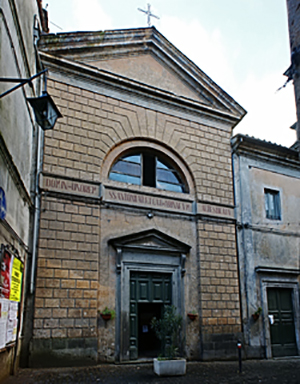


Along Via Roma, behind the church of Sant’Agostino is the church of Sant’Antonio Abate and Santa Caterina. The façade, which dates back more than a century ago, was built to a design by the architect Guglielmo Meluzzi and incorporates the plastic motifs of the ground floor of the nearby Sant’Agostino bell tower.
Info: Toll-free number: 800-411834
torrejulia@tiscali.it www.laperegina.it
0763 7309206 Tourist Office of the Municipality of Acquapendente turismo@comuneacquapendente.it
Info Parish: Tel: 0763/734200


CHURCH OF SAINTS ANTONIO AND CATERINA
HISTORY AND DESCRIPTION
Along Via Roma, behind the church of Sant’Agostino is the church of Sant’Antonio Abate and Santa Caterina. The façade, which dates back more than a century ago, was built to a design by the architect Guglielmo Meluzzi and incorporates the plastic motifs of the ground floor of the nearby Sant’Agostino bell tower. In the center of the façade there is a large bull’s-eye window. Below, runs the inscription “D.O.M IN HONOREM SS. ANTONII ABET CATHARINAE V.M. AEDES DICATA ”(church consecrated to God excellent maximum in honor of the saints Anthony the abbot and the virgin martyr Catherine). In the small bell tower of the church there are two bells, the largest (76 cm high and 64 cm in diameter) was cast by Sebastiano di Acquapendente in 1621 and bears the following inscription: + DISCIPLINATUR ULN. COC. S.ANT.ACQUAPENDEN.1621-BAST.AQUAP.FEC. Upon entering the church, a single nave covered with a barrel vault welcomes the faithful. Above the cornice that runs along the entire nave, the Sacraments are represented with symbolic figures. On the right wall we find the chapel dedicated to San Rocco built in 1890. Here the wooden statue of San Rocco from the ancient lazaretto of Acquapendente is placed above the altar. The saint is represented with his attributes; the dog and the pilgrim’s staff. The chapel occupies part of the atrium of the sacristy which was built between 1890 and 1893 by the will of Monsignor Angelo Gessi. To decorate the chapel, a marble altar built in 1964 decorated with graffiti by the artist Mario Vinci with grapes and ears. A little further on we find the wooden statue of the sixteenth century mentioned by Msgr. P. Mignucci in September 1652; is the statue of Sant’Antonio Abate with the book and the cross, which is carried for the grandiose celebrations held by the Aquesians in honor of the saint every year on January 17th. Behind the main altar, in the apse, is the niche that housed the wooden statue of Saint Anthony the Abbot. The arched niche is enriched by a wooden decoration. Below, we find a painted inscription attesting to the date of the restoration carried out by Gioacchino Rotili in 1896. AERE JOACHIM ROTILI ET CONFR. REST. YEAR MDCCCXCVI. To the left of the niche is the image of Saint Catherine with her wheel, symbol of her martyrdom, and to the right of her, Saint Anthony the Abbot. The main altar is decorated with graffiti made by the local artist Mario Vinci, the apse basin and the vaults were made by Ennio Luzzi in 1965, both natives of Acquapendente.The banner of the brotherhood of San Rocco and a wooden crucifix are placed in the area in front of the main altar. Continuing towards the exit, on the left wall after the confessional, there is the wooden statue of the Madonna of Loreto.
ESSENTIAL BIBLIOGRAPHY
AA.VV., Acquapendente and its territory. Lazio Region, Department of Culture, Entertainment, Sport and Tourism. Regional Directorate for culture, sport and tourism, area for the enhancement of the territory and cultural heritage. Avellino 2004, Agostini, The churches of Acquapendente, Acquapendente 1987;
Chiovelli R., From the ruins of the Castro war to the eighteenth-century rebirth, in Chiovelli R. Mengali M.A.L., Guglielmo Meluzzi architect of post-unification Acquapendente. Acquapendente 2003.
Costantini N., Historical Memoirs of Acquapendente. Acquapendente 1982.
The works of art in the church of Sant’Antonio and Santa Caterina di Acquapendente were cataloged on the inventory models in 1993 by the BAS Superintendency of Rome (Catalographer A. Capriotti); the cards were revised in 2003 by Fr. Grassi for the Lazio Region.
Acquapendente city of art, Church of Sant’Antonio and Santa Caterina.