With the destruction of the city of Castro and the erection of the new diocese of Acquapendente, the city became a bishopric and the bull of November 13, 1649 of Innocent X made its constitution official. The community, with the help of the brotherhoods, bought and offered the bishop the palace of the Oliva family. On the first floor there is the historical archive of the Dioceses of Castro and Acquapendente.
Info: www.centrodocumentazioneviterbo.it CEDIDO 076132558.
On the second floor there is the museum of the city and a section dedicated to the Via Francigena. Info: MUSEUM OF THE CITY Telephone: 0763 7309205 Cultural Office of the Municipality of Acquapendente
museo.civ.dioc@comuneacquapendente.it



THE EPISCOPAL PALACE (Palazzo Vescovile)
HISTORY AND DESCRIPTION
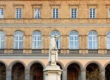
With the destruction of the city of Castro and the erection of the new diocese of Acquapendente, the city became a bishopric and the bull of November 13, 1649 of Innocent X made its constitution official. The community, with the help of the brotherhoods, bought and offered the bishop the palace of the Oliva family.
The current form is due to the restorations carried out at the end of the 17th century and the enlargements carried out since the mid-18th century. In the main entrance portal you can read the words “.ALFONSUS. ARCHIEPS. AMALF. S. D. N. PP. SACR. 1544 “which remembers the first owner of the building,
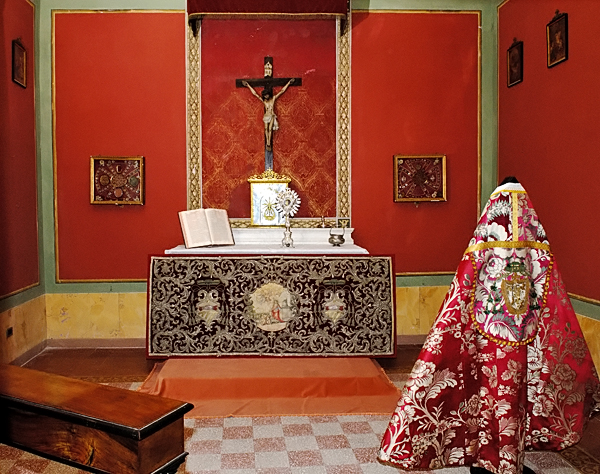
A recent restoration of the structure made it possible to allocate a part of it to the Diocesan Civic Museum. On the first floor of the building there is, in addition to the bishop’s apartment, the curia archive, the library of the former seminary and various works of art belonging to various churches.
On the ground floor you can visit the old prisons on whose walls the testimonies left by the condemned are still legible, graffitied on the wall. Conference rooms have been created in other rooms on the ground floor. The historical archive of the Dioceses of Castro and Acquapendente is located on the first floor. In recent years, under the coordination of the manager Prof. Luciano Osbat, the documentation stored in the archive has been rearranged and the inventories can be consulted on site and online at www.centrodocumentazioneviterbo.it. The present documentation has a dating between the fifteenth century. and the 21st century. For information in addition to the site
www.centrodocumentazioneviterbo.it you can contact the CEDIDO directly at 0761325584 by e-mail at cedi.do@libero.it. Since 2011 a new section dedicated to the Via Francigena has also been opened on the second floor. The new section is rendered through multimedia and plastic didactic apparatuses reproducing the Via Francigena through the various regions of Europe, with particular attention to the Lazio section and the urban crossing of Acquapendente influenced, since the Middle Ages, by this important medieval artery, both as a border point, both defensive and control.