


FIDI TAURELLI PALACE
Located on the most important street in the center, it is part of that decorative program that increased the construction of monumental buildings at the turn of the eighteenth century pursued by the wealthy families of the city.


Located on the most important street in the center, it is part of that decorative program that increased the construction of monumental buildings at the turn of the eighteenth century pursued by the wealthy families of the city.
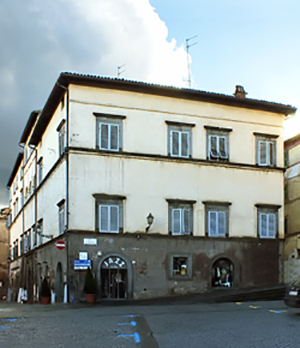
In front of the church of Santo Stefano is the Benci-Caterini palace, with an arched portal under a Doric-type entablature. The keystone, instead of being decorated with the traditional coat of arms, shows a grotesque mask.
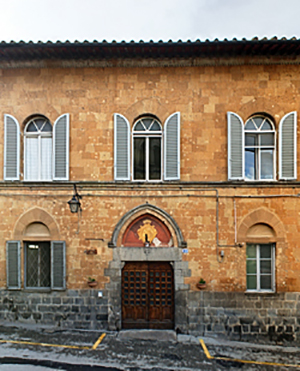
The hospital of Santa Maria was built in 1421, grouping three previous structures: the hospital of the Trinity, the hospital of San Rocco and the hospital of San Gregorio, which stood on the stretch of the Via Cassia, known as the Roman road. It was a rest, shelter and assistance facility for pilgrims and a place of care for the sick.
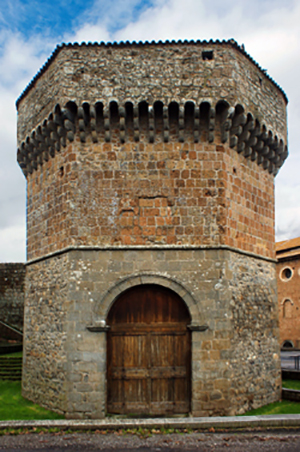
The City Museum constitutes a real integrated city museum system with its three exhibition venues all located along the road axis that coincides with the urban crossing of the Via Francigena, still today the backbone of the urban layout of the historic center. At the southern entrance of the city is the branch of the Torre Julia de Jacopo which houses an important collection of archaic majolica.

The City Museum constitutes a real integrated city museum system consisting of three exhibition venues. The headquarters are located in the halls of the Bishop’s Palace, built in 1649. Here you can admire the collections of diocesan sacred art and the numerous ceramic finds, which illustrate the history of Aquesian ceramics from the Middle Ages to the present day.

In 1923 the Monument to the Fallen of the war of 1915 – 1918 was placed in the square. The bronze sculpture that decorates it is the work of the sculptor Uno Gera from Ripatransone.

The sculptor Tito Sarrocchi created the statue in 1888 with extreme meticulousness and with the aim of creating the best conditions for the usability of the monument for the public. Having no references, in addition to an ancient and inaccurate portrait, Sarrocchi decided to resume the physiognomy of his friend Giuseppe Porri, a cultured Sienese bookseller-publisher who gave his city an interesting collection of books and antique prints.

The current denomination of source of the “Mascheroni” came into use only when the source was renovated in the nineteenth century thanks to the intervention of the architect G. Meluzzi, who oversaw the project with pilasters and cornices, placing grotesque masks around the torches water. The source is the scene of the small square that opens below the level of Via XV Maggio.

The appearance of the source of the Rugarella is due to the urban reorganization of some of the areas of the city which took place in the second half of the nineteenth century in Acquapendente. The source, which is located within the city, is known as the “source of Sugarelle or Rugarella” due to its location in the street of the same name. At the end of the nineteenth century, thanks to the intervention of the architect Guglielmo Meluzzi, the source was renovated, giving it its monumental appearance.

The former convent of San Francesco di Acquapendente has seen in recent years a series of restoration interventions that have made it possible to host the Pinacoteca section of the City Museum in the premises of the former sacristy and the offices of the Eco in one of the former convent wings. Point of the Monte Rufeno Nature Reserve.